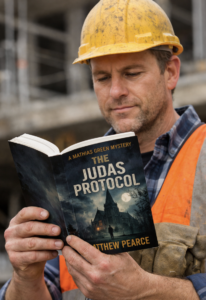
Construction work builds a certain kind of person. It teaches you to think ahead, pay attention, stay calm under pressure, and respect the cost of small mistakes. It also trains you to notice what other people miss. That is exactly why Mathias Green: The Judas Protocol feels like such a strong fit for readers who work in construction. This is not a soft, slow, wandering story. It is a novel built around tension, discipline, hidden structure, and the kind of detail that matters. The book centers on a theology professor found dead inside a locked archive vault, with an uncatalogued manuscript at the center of the mystery, and Mathias Green is pulled into a case involving secrecy, old deaths, and a text that appears to carry instruction rather than comfort. That kind of setup has weight to it. It rewards readers who understand pressure and precision, not just readers looking for noise.
Construction Workers Respect Systems, and This Story Is Built on One
Anyone in construction knows that big outcomes depend on small systems. A schedule, a site plan, a sequence, a safety step, a load calculation, a checklist, a handoff, a missing note in the wrong place—those things decide whether a day runs smoothly or falls apart. That same mindset makes The Judas Protocol satisfying. The story is not just about suspense for suspense’s sake. It is about structure. It is about following signs, recognizing patterns, and understanding that what looks accidental at first often is not accidental at all. Construction workers live inside systems every day, and that makes them unusually prepared to appreciate a mystery that is layered instead of sloppy. The working world they know is the same world constantly tracked by outlets like Engineering News-Record, Construction Dive, and Construction News, where planning, execution, risk, and consequences drive the conversation.
Pressure Is Familiar Territory for People in Construction
One reason this novel connects so naturally with construction workers is simple: pressure is already part of their normal life. They know what it means to keep moving when conditions are not perfect. They know what it means to solve problems without panicking. They know that when the margin for error gets thin, character matters. The Judas Protocol operates in that kind of atmosphere. It does not lean on chaos alone. It leans on controlled pressure. That matters because construction readers usually do not want a story that feels flimsy or overdramatic. They want something that feels sturdy. They want stakes that feel earned. They want tension that builds like a project with real weight behind it. In an industry where outlook reports and coverage from groups like the Associated General Contractors of America and Associated Builders and Contractors keep returning to uncertainty, labor strain, cost pressure, and the need for disciplined execution, a story about keeping your head while everything tightens feels immediately relatable.
Precision Is Not Just a Work Skill. It Is a Reading Skill Too
Good construction workers are trained observers. They notice alignment, sequence, quality, inconsistency, and gaps. They can walk onto a site and sense when something is off before anyone says a word. That same instinct makes this book land harder. The Judas Protocol is the kind of novel that invites careful reading. It asks the reader to pay attention to the hidden thing, the missing thing, the thing that officially should not exist but clearly does. That is a powerful hook for someone whose job already depends on detail. In construction, precision is never just about perfectionism. It is about protecting the whole project. In a suspense novel, precision works the same way. The strongest tension often comes from what one detail changes. That is why readers drawn to workmanship, order, and exactness tend to enjoy stories where nothing feels thrown together. Even broad background resources like Wikipedia’s construction overview reflect how much of the field revolves around coordinated activity, layered trades, and attention to how complex pieces fit together.
The Best Construction Minds Understand Hidden Risk
Construction workers know that the most dangerous problems are not always the loud ones. Sometimes the real issue is hidden behind a wall, buried under a slab, tucked into a bad assumption, or ignored because somebody thought it would probably be fine. That is one reason a novel like this works. The emotional engine of The Judas Protocol is hidden risk. A death is dismissed as an anomaly. A manuscript officially does not exist. A phrase is discovered that is not presented as prayer or confession, but as instruction. That combination creates the same kind of mental tension construction workers deal with in real life. It is the feeling that there is more under the surface than people want to admit. It is the instinct that the official version is not the whole version. Readers who work with buildings, deadlines, inspections, safety concerns, and unseen liabilities already understand why hidden danger is often the danger that matters most. Agencies and industry sources like OSHA’s construction safety resources, the U.S. Census Bureau’s construction spending releases, and NAHB housing economics all reflect a field where unseen risk, changing conditions, and disciplined response are part of daily reality.
A Construction Worker’s Mindset Fits the Tone of Christian Suspense
Not every reader wants fluff. A lot of people in construction spend their days in environments where effort is visible, consequences are real, and excuses do not carry much weight. That kind of person often wants fiction that respects seriousness. That is where christian suspense novels can become such a strong category fit when they are written with gravity, tension, and intelligence. The Judas Protocol has a premise that feels intellectually sharp, but it also carries moral pressure, spiritual undercurrents, and a sense that truth matters even when it is dangerous to uncover. For construction workers, that rings true. They know what it means to be responsible for something bigger than themselves. They know that integrity is not theoretical. It shows up in how you work, how you respond, and what you do when cutting corners would be easier. A novel that treats truth, discipline, and danger with seriousness is naturally going to resonate with readers shaped by that kind of world.
This Book Offers a Different Kind of Escape
People sometimes talk about reading like it has to be soft to be restful. That is not always true. For many construction workers, the best kind of escape is not something weak or forgettable. It is something immersive. It is something that pulls the mind into a different problem set while still respecting the reader’s intelligence. The Judas Protocol offers that kind of escape. It lets a reader step out of the noise of the day without dropping into something hollow. Instead of giving them empty distraction, it gives them a mystery with shape, momentum, and weight. That matters. After a long day of physical effort, problem-solving, coordination, and responsibility, a novel that is sharp and purposeful can feel more refreshing than something lightweight. It keeps the brain engaged while shifting the context. It honors the fact that many blue-collar readers want more than mindless entertainment. They want story, but they also want substance.
Construction Workers Build What Other People Depend On
That reality creates a mindset that fits this novel especially well. Construction is not just labor. It is responsibility carried in public view. What gets built affects how people live, work, gather, heal, worship, and move through the world. That creates pride, but it also creates seriousness. The Judas Protocol works because it respects seriousness. It assumes the reader can handle tension, layered meaning, and consequences that unfold step by step. It treats mystery like something built, not improvised. For construction workers, that feels familiar. They know that the strongest outcomes do not happen by accident. They are assembled under pressure, with care, through disciplined effort. A novel that mirrors that logic feels satisfying on a deeper level than a story built only on gimmicks.
Conclusion
Mathias Green: The Judas Protocol is a smart recommendation for construction workers because it speaks to the very qualities their work strengthens every day: focus, discipline, endurance, pattern recognition, and respect for the hidden consequences of small details. This is a suspense novel with a solid framework, real tension, and a premise that immediately rewards readers who think in terms of structure and pressure. It does not ask construction workers to become a different kind of person in order to enjoy it. It meets them where they already are. For readers who spend their days building, checking, correcting, and carrying responsibility, this book offers a mystery that feels built with the same kind of care.